
East Coast Weather Alert: Twin Storms May Affect NJ

Twelve-Year-Old Child Injured by Car While Riding Electric Scooter in NJ
September 25, 2025
Man Faces Charges for Setting Fire at Ocean County Apartment
September 27, 2025East Coast Weather Alert: Twin Storms May Affect NJ

East Coast Weather Alert: Twin Storms May Affect NJ
The most recent projections indicate that two new tropical dangers are developing in the Atlantic Ocean and may group near each other and the U.S. East Coast in the coming week. In some areas of New Jersey, the storms may bring wind, rain, and hazardous surf conditions.
AccuWeather forecasts stated that a tropical downpour that formed late Tuesday in the central Atlantic might make landfall in Bermuda as a hurricane by the beginning of next week. As early as late this week, a tropical wave close to the Lesser Antilles may also develop into a named tropical storm close to the Bahamas.
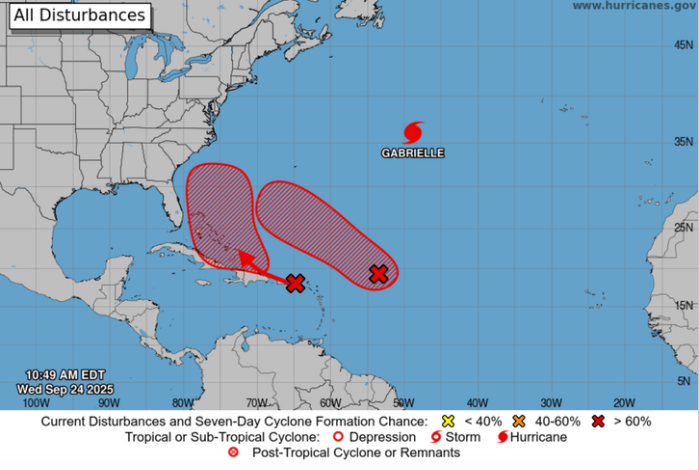
A system several hundred miles east of the Leeward Islands is still displaying signs of organization in the central Atlantic, according to the National Hurricane Center, and favorable conditions are expected for additional development.
As of right now, the storm is predicted to move between Bermuda and the East Coast of the United States. It is anticipated to deliver rain and strong gusts to Bermuda beginning on Sunday night.
Beginning this weekend, beaches throughout the Bahamas and the East Coast may be affected by the rip currents and rough surf that this storm is expected to produce, according to DaSilva. "People should keep a close eye on forecast updates in Bermuda and throughout the East Coast. The storm can intensify rapidly.
Over the northeastern Caribbean Sea, forecasters are also keeping an eye on a tropical wave that has moved further west than any other system this season and is causing erratic showers and thunderstorms. According to the National Hurricane Center, the storm, named Invest 94L, has an 80 percent chance of turning into a tropical depression over the course of the next seven days.The National Hurricane Center forecasters predict that this wave will proceed west-northwestward at 15 to 20 mph, bringing with it gusty gusts and heavy rains into Puerto Rico and the Virgin Islands on Wednesday, as well as over the Dominican Republic starting Wednesday evening.
Before slowing down and turning northwest when it approaches the southwestern Atlantic later this week, the storm is predicted to develop into a tropical depression close to the Bahamas.
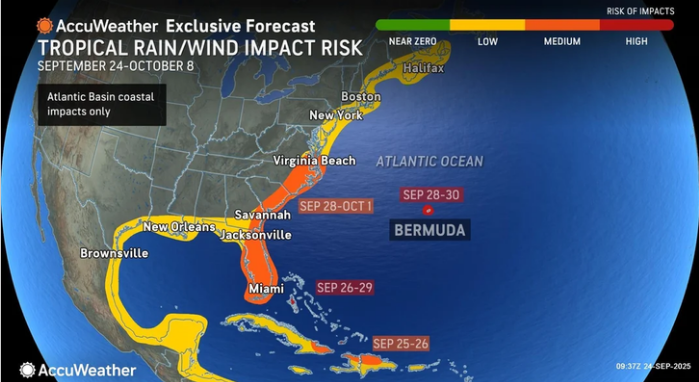
Norcross stated that the storms might hit the East Coast by the end of the weekend or the beginning of the following week, while it is still uncertain how the prediction will develop over the next few days.
According to certain models, the two systems might interact to produce the uncommon phenomena known as the Fujiwhara Effect.
According to the National Weather Service, the Fujiwhara Effect occurs "when two hurricanes spinning in the same direction pass close enough to each other, they begin an intense dance around their common center." "The smaller hurricane will circle the larger one and eventually crash into its vortex to be absorbed if the larger hurricane is much stronger than the smaller one.'
According to the NWS, if the storms are of comparable intensity, they may combine as they approach one another or circle one another before veering off in various directions. "On rare occasions, when the hurricanes combine, the effect is additive, creating a single, larger storm rather than two smaller ones."
According to Norcross, a number of models indicate a less certain development zone of 94L across the Bahamas, along the east coast of Florida, and in the Southeast, while a somewhat high-certainty path of 93L is seen in the approximate area of Bermuda. Check your local weather forecast for updates.


